
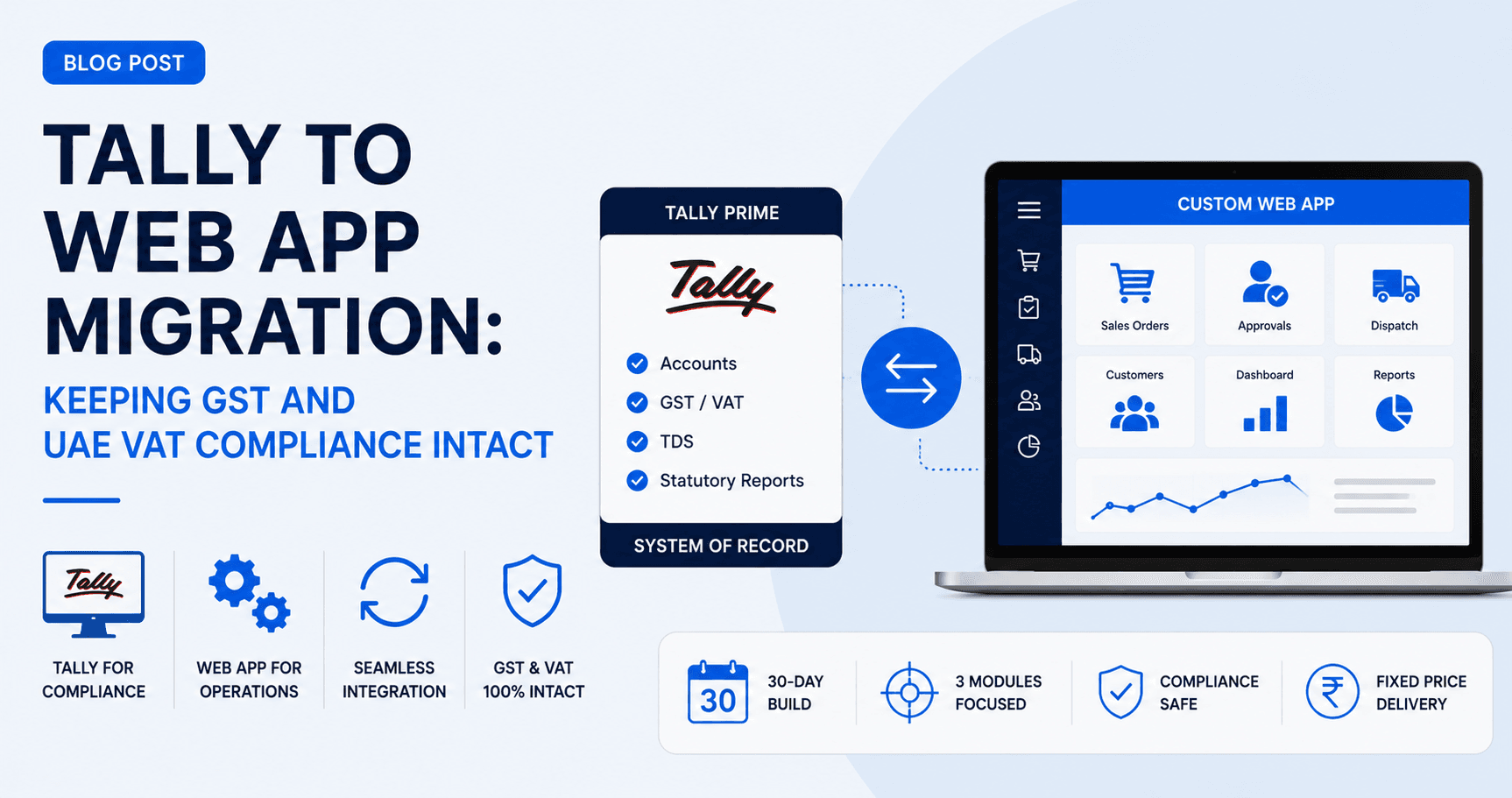
Most "Tally migration" conversations start with the wrong question. They ask whether to leave Tally. The right question is whether Tally should keep doing the one job it does well, while a custom web app takes over the operational layer that Tally was never built for.
We have been on both sides of this conversation across India and the UAE. Family businesses in Mumbai and Dubai, professional services firms in Kochi and Pune, small trading groups in Sharjah. The pattern is the same. Tally is doing accounts and tax filing competently. Operations have outgrown what Tally can hold, so spreadsheets, WhatsApp, and the owner's memory have filled the gap. The owner is being told to "migrate off Tally" and is rightly nervous.
This post is for the founder or finance head who suspects the right answer is not migration. It is layering.
What Tally is genuinely good at
Tally Prime, in its standard configuration, is one of the most reliable accounting and statutory filing tools available in the Indian and UAE markets. It does GSTR-1, GSTR-3B, GSTR-9, and TDS filings cleanly. It exports VAT returns for UAE filing without drama. Audit firms in India and the GCC know how to read it. Your CA already trusts it.
Removing Tally from the stack means rebuilding three things. Statutory return preparation. Audit trail in the format your CA expects. The reconciliation logic that handles the edge cases your business has accumulated over years of operation.
Rebuilding those three things is technically possible. It is also a six to twelve month project that adds zero value to your operation. The customer does not care that your invoicing platform is shinier. The auditor does not give you points for it. The tax department does not file your returns faster.
The reason most "leave Tally" projects stall halfway is that the team building the replacement underestimates how much hidden compliance logic Tally absorbed over the years. By month four, the team is rebuilding GSTR-2B reconciliation from scratch and the project quietly dies.
What Tally is genuinely bad at
The list is short and the list is real.
Tally is bad at multi-user collaborative operations. Two people editing the same voucher at the same time is awkward. Three people across two locations is painful.
Tally is bad at customer-facing or supplier-facing workflows. There is no clean way for a customer to place an order, see their account statement, or get an automated invoice receipt. There is no clean way for a supplier to confirm a purchase order or see their payment status.
Tally is bad at custom approval flows. If your purchase requires three sign-offs depending on the amount, Tally can be made to do it with significant customisation effort, but the resulting setup is fragile.
Tally is bad at being a phone-first interface. The owner who wants to see today's collections on the way to a meeting cannot do it cleanly. The driver who wants to mark a delivery dispatched cannot do it at all.
These are real weaknesses. None of them require leaving Tally. All of them can be solved by a web app sitting beside Tally.
The pattern: Tally below, web app above
The model we use is straightforward. Tally remains the system of record for accounting, GST, VAT, TDS, and statutory reporting. The custom web app becomes the operational system for everything else.
The two systems exchange data through a defined seam. Sales orders, purchase orders, deliveries, and customer payments captured in the web app push into Tally as vouchers. Tally remains the single source of truth for ledgers, returns, and audit. The web app remains the single source of truth for operations, approvals, and customer or supplier experience.
This pattern works because it does not ask anyone to change what they already do well. The CA still works in Tally. The auditor still gets the same export. The GST and VAT returns still file the same way. What changes is that the operations team stops living in Excel and WhatsApp.
The integration seam is what matters. Tally's HTTP request and ODBC interface, plus the export and import format, are stable enough to build against. We push voucher data with the right narration, ledger reference, and tax code, and Tally treats it as native input.
What we typically build in 30 days
The exact three modules vary by business, but the shape is consistent.
For a trading firm, the modules are usually a customer order intake, a stock and dispatch board, and an owner dashboard with collections and credit exposure. Sales invoices flow into Tally automatically.
For a professional services firm, the modules are usually a client intake form, an engagement and billing tracker with deadline alerts, and an invoice approval flow. Once approved, invoices push into Tally as service vouchers.
For a small manufacturer or job-work shop, the modules are usually a job card system, a material consumption tracker, and a dispatch and invoicing layer. Job costing remains in the web app. Final invoicing pushes into Tally.
Each of these is The 30-Day Pilot Build. Three modules, fixed scope, fixed price, dual guarantee. ₹1,00,000 in India or USD 5,000 in the UAE. 50% on kickoff, 50% on delivery.
What stays in Tally and what moves
A short, honest list.
Stays in Tally: chart of accounts, ledgers, vouchers (final), GSTR returns, VAT returns, TDS, audit trail, balance sheet, profit and loss, year-end closing, statutory reports.
Moves to the web app: customer master with credit limits and contact preferences, sales order capture, purchase order workflow, approvals, dispatch tracking, delivery confirmation, customer-facing statements and invoices, supplier-facing portals if needed, owner dashboards, KPI reporting.
What gets pushed from web app to Tally: completed sales invoices as vouchers, approved purchase invoices as vouchers, payments received and paid, journal entries for adjustments only when necessary.
What never crosses the seam: draft invoices, in-flight approvals, cancelled orders, internal notes, customer conversation history.
The discipline of the seam is what keeps GST and VAT compliance intact. Tally only sees finalised, approved, postable transactions. The web app holds everything before that point.
How the 30 days run
The clock starts after a 20-minute fit call. Week one is Map. Two hours with the owner and the finance lead, plus 30 minutes with the CA if available. We document the existing Tally setup, the existing operational workflow, and the seam between them.
Week two is Scope. We pick the three modules and define the Tally integration cleanly. Voucher format, narration template, ledger references, tax codes. Sign-off lands by day 7.
Weeks three and four are Build and Ship. The web app is live on day 17 in a staging environment. Real users test it on day 22. Production deploy on day 28 with parallel running for the first week. Tally remains untouched until parallel running confirms everything is posting correctly.
This is the named mechanism. Map, Scope, Build, Ship.
The dual guarantee
If we miss the 30-day delivery date, we keep building free until it ships, plus 25% off the next engagement. No exceptions.
After 14 days of real use, if the system is not solving the problem we scoped, we refund 50% of what you paid. You keep the code, the deployment, the documentation, the Tally integration, everything.
The integration is yours. The documentation explains the seam well enough that any other Tally-aware developer can extend it. There is no lock-in.
Who this is not for
We do not migrate businesses off Tally entirely in 30 days. That is a 6 to 12 month project with real risk and we will not pretend otherwise on a Pilot Build.
We do not rebuild the GSTR or VAT engine. Tally already does this and your CA already trusts it. Replacing it is the wrong battle.
We do not work with businesses that do not currently use Tally cleanly. If your books are messy, fix the books with your CA first. The Pilot Build assumes Tally is a healthy system of record.
If you run a business in India or the UAE on Tally, your operations have outgrown spreadsheets and WhatsApp, and you want a working web layer above Tally without breaking compliance, we are the right starting point.
The next step
A 20-minute fit call. We look at your current Tally setup, your operational workflow, and the gap between them. If a Pilot Build solves the gap, we book you. If you need a different scope, we say so.
We are limited to two pilot builds in delivery at a time.
Book the call from monolithia.global, or send a one-line note to hello@monolithia.global describing the operational workflow that Tally currently does not handle.