
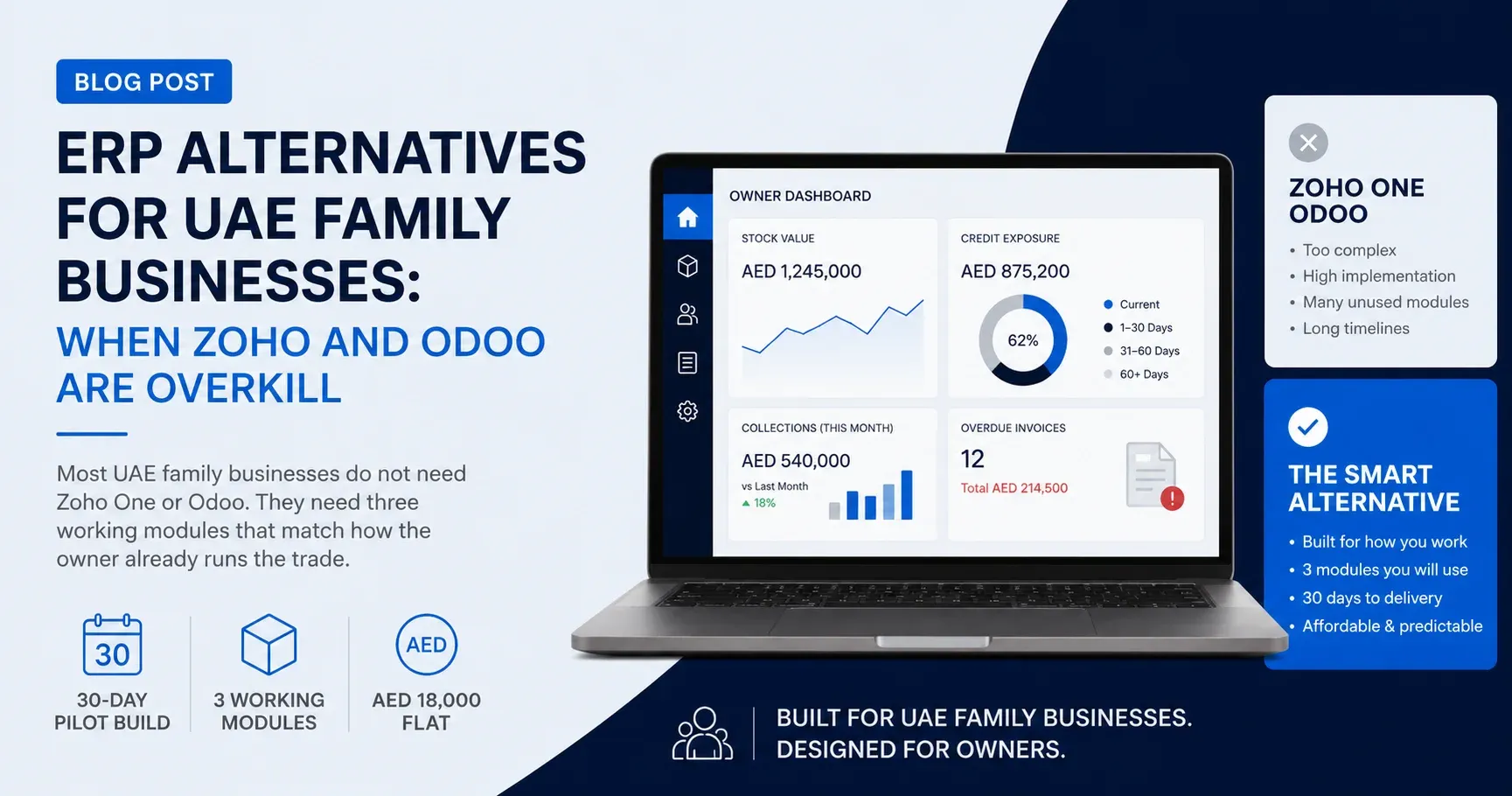
If you run a UAE family trading group or a multi-entity services firm and someone has pitched you Zoho One or Odoo in the last 12 months, you have already lived through the reason this post exists.
The pitch sounds reasonable. One platform, all modules, VAT-ready, multi-entity, Arabic interface. The implementation quote sits between AED 60,000 and AED 250,000 depending on the partner. The timeline is "three to six months". You sign because the brand is known and the rep is professional. Six months later, half the modules sit unused, two staff are still entering invoices into both Tally and the new system, and the owner is back to checking WhatsApp for stock confirmations.
We have walked into this exact situation in Dubai, Sharjah, and Ajman more than once. The problem is not Zoho or Odoo. They are real products with real engineers. The problem is that a UAE family business with 8 to 40 staff, one or two trade lines, and an owner who knows every customer by name is not the buyer those products were designed for.
This post is for the founder or family head who is being told they need an ERP, suspects they do not, and wants a clear alternative.
What a UAE family business actually runs on
Before any alternative makes sense, name the current reality honestly. Most UAE family businesses we audit run on the same five tools.
Tally for accounts and VAT filing. Excel for stock, pricing, and customer lists. WhatsApp Business for customer orders and supplier confirmations. A shared Google Drive for purchase orders, invoices, and the occasional contract. The owner's phone holds the rest, including the rate card adjustments, the credit limits, and the memory of which customer paid late last quarter.
This is not a failure of digitisation. This is a working system. It survived the VAT rollout in 2018. It survived the corporate tax rollout in 2023. It survives audits because Tally exports clean.
The real bottleneck is not "we are not on an ERP". The bottleneck is that the system depends on the owner being available. When the owner travels to India or Saudi for two weeks, the operation slows down. When a junior staff member leaves, the knowledge leaves with them. When a customer asks for a six-month account statement, someone spends 90 minutes in Tally and Excel reconciling it.
That is the problem worth solving. An ERP solves it the way a hospital solves a sprained ankle. Effective, expensive, and overscoped.
The Zoho and Odoo problem in real numbers
Here is what we see when family businesses go through a full Zoho One or Odoo rollout.
The licence cost is the small number. Zoho One sits at roughly AED 165 per user per month at standard pricing. Odoo runs from a free community edition to roughly AED 100 per user per month for the standard cloud version. For 15 users, that is between AED 18,000 and AED 30,000 a year. Manageable.
The implementation cost is the real number. UAE Zoho and Odoo partners typically quote AED 60,000 to AED 250,000 for a multi-module rollout, including data migration, customisation, training, and the first three months of support. That number is honest. The work involved is real.
The hidden cost is what nobody quotes. Two staff members spend half their week for three months learning the new system, doing parallel data entry, and chasing the partner for fixes. The owner spends evenings approving customisations they do not fully understand. By month four, the team is using one ERP module (usually invoicing) and ignoring the rest.
We are not saying ERPs do not work. We are saying that a 15-person UAE trading firm rarely uses more than 20% of an ERP's functionality, and the 20% they do use does not justify the rollout.
The alternative: three working modules built for how you already run
The alternative is not "do nothing" or "cobble together more spreadsheets". It is a custom build that solves the three pains the family business actually has, with no module you will not use.
The first module is a single owner dashboard. Stock positions across the trade lines, current credit exposure by customer, this month's collections versus last month, and a list of any invoice unpaid past 30 days. One screen. The owner sees it on the phone in the car between meetings.
The second module is a customer-facing order intake that talks to WhatsApp. The customer sends an order on WhatsApp. The system parses it, confirms stock, sends back a price, and once accepted, drops the order into the dispatch queue. Tally still handles the VAT invoice. The handoff is automatic.
The third module is a staff-facing operations layer. Whoever is in the warehouse or behind the counter can see the day's confirmed orders, mark them dispatched, and capture the proof of delivery. The owner sees the same data in the dashboard.
That is the build. Three modules. 30 days. USD 5,000 flat rate (AED 18,000 approx). 50% on kickoff, 50% on delivery. We call it The 30-Day Pilot Build.
Where the build sits next to your existing tools
We do not replace Tally. We do not replace WhatsApp. We do not replace your existing supplier conversations or your auditor's process.
Tally stays for accounts, VAT, and corporate tax filings. The pilot build pushes invoice data into Tally automatically through CSV import or API where Tally allows it. Your auditor sees no change.
WhatsApp Business stays for customer conversations. The pilot build sits alongside it as the order capture and acknowledgement layer. Your customers do not learn a new app.
Excel disappears slowly. The first sheet to go is usually the stock list. The pricing sheet typically goes by month two. The customer list moves into the dashboard from day one.
This is the honest scope. We are not selling you a Tally replacement. We are not selling you a WhatsApp replacement. We are selling you the layer between them that has been missing.
How the 30 days run
The clock starts after a 20-minute fit call. The first week is Map. Two hours with the owner, ideally with one operations staff present. We document the current order-to-dispatch flow end to end and produce a one-page operational map.
The second week is Scope. We pick the three modules together and lock them. Arabic interface where needed. Multi-entity if you run more than one trade licence. Approvals lock on day 7.
Weeks three and four are Build and Ship. You see a working version on day 17. Your operations staff use it for real on day 22. We deploy and hand over on day 28. Days 29 and 30 are buffer for the two or three things we did not predict.
This is the named mechanism. Map, Scope, Build, Ship. Four phases. Same shape on every Pilot Build.
The dual guarantee
Two specific commitments, written in buyer language.
If we miss the 30-day delivery date, we keep building free until it ships, plus 25% off the next engagement. No exceptions.
After 14 days of real use by your team, if the system is not solving the problem we scoped, we refund 50% of what you paid. You keep the code, the deployment, the documentation, everything.
The work is real work and it is yours either way.
Who this is not for
We do not do enterprise ERP rollouts. If your group has more than 100 staff across multiple countries with consolidated reporting requirements, you genuinely need SAP or Oracle, and we will say so on the call.
We do not do regulated industries in month one. Healthcare, financial services with central bank licensing, construction with VAT-on-supply complexity. These need specialist scopes, not a 30-day pilot.
We do not do hardware installs. Barcode scanners, POS terminals, handheld inventory devices. We can integrate with what you already have. We do not procure or install.
If you are a UAE family business between 8 and 40 staff, running on Tally, Excel, and WhatsApp, and you suspect Zoho or Odoo is the wrong answer, we are the right starting point.
The next step
A 20-minute fit call. We look at your current setup, your trade lines, your team size, and we tell you whether the Pilot Build solves the actual problem. If it does, we book you. If you genuinely need an ERP, we will say so and point you to two partners we trust in the region.
We are limited to two pilot builds in delivery at a time. That is a real capacity constraint.
Book the call from monolithia.global, or send a one-line note to hello@monolithia.global describing your current setup and team size.